Sunday, November 25, 2012

Walk the Moon - The Venue - Saturday, November 24, 2012


This review is also available on http://concertaddicts.ca/2012/11/26/review-walk-the-moon-venue-november-24th-2012/ (or for the shorter URL: http://goo.gl/tEMDl
Photos below are copyright to me. 

Every so often the concertgoer is rewarded for arriving early with a find. For me, over the years, these have included Three Days Grace, Guster, The Push Stars, Ed Sheeran, and recently, Walk the Moon. When Walk the Moon opened for Kaiser Chiefs in Vancouver earlier this year, they distinguished themselves by being “the opening band I actually liked”. Now it’s 6 months on, I’ve heard both Anna Sun and Tightrope on Vancouver and Victoria radio (thank you, The Peak and The Zone), I wanted to see how they’d grown and if Vancouver would follow them to a headline show.

But first, we got to know Family of the Year a bit: they’re based in Los Angeles, the lead singer and the drummer are brothers, the latter even attended UVic for a year (then he dropped out to join a band), this was the last night of their tour together with Walk the Moon, and they all sing and play instruments: lead guitar (electric and acoustic), rhythm guitar, drums, piano keyboard, and bass. They were all lined up in a row parallel to the front of the stage (partially because WtM’s gear was upstage), but they’re all so very animated in their performance, I hope they never put the drummer Sebastian in the back – the fun he has playing, and the others too, is infectious. Stylistically, they are modern, roots rock-influenced melodies with a tinge of pop (or, as iTunes tells me “Indie Rock”). They were grateful to the 100ish people who came out early (you’re very welcome, by the way). I quite liked them; they were toe-tapping, body-moving, head-nodding cool. For the 5th song they played, Walk the Moon came on stage halfway through and finished it with them. For Hero (the only one of their songs I’d heard on the radio before), I saw a few people two-stepping, which was kind of cute. There was great audience participation for Stupidland as the drummer moved up to share a microphone with his brother playing two tambourines which he then handed to audience members so he could jump back behind the kit when the time came. By the time Family of the Year were done (they played 10 songs for their 45-minute set) another 200 or so people had arrived, many of them painted, and even the balcony had started to fill. 

The CD they were promoting, Loma Vista, which I bought, doesn’t do them justice. Comparing the recording to the live performance, I’d say if you’re expecting the borderline folksy band you hear on the recording, you’re not going to get it, not even if you turn it up real loud. They have a great energy live, singing and playing their collective hearts out, and it fleshes the songs out to give them much more body.    

Setlist included Buried, The Stairs, Diversity, St Croix, Hero, Stupidland, Living on Love, In the End.  

Here’s what I know about Walk the Moon: they’re a four-piece and from Cincinnati, Ohio. Also, it’d been 6 months to the day since I saw them perform for the first time. They mentioned playing across the street when they were here with Kaiser Chiefs. Since then, they’ve toured Europe opening for Fun. (when they wrote Young Shoes) and their songs have achieved some radio exposure. The very first thing I noticed that was different is their level of confidence. Although far from home, immensely grateful, and just a little overwhelmed at times at the positive audience response, this was a headline gig in support of their self-titled CD and they “brought it”. If this is how much energy they have for the final show of a tour, then up until now, it must’ve been “off the hook”.

The other thing I noticed, and it probably goes hand in hand with confidence, is that audience participation is assumed. They just do something – clapping, hands in the hair, arms over your hard swinging side to side, singing back (not solo, we’re not there yet) – the audience was there for Walk the Moon. Literally. They have such energetic performance styles and upbeat songs that are pop, with great hooks and super fun syncopation. The lead singer Nicholas is multi-tasker as keyboardist and 2nd drummer.  

Stand-outs were Jenny, almost a ‘ska meets disco’ number’ that the audience quickly learned some of the words to I’m not going to take it from you, I’ll let you give it to me – very kind, in an audience context sort of way. In another stylistic marriage, I liked Shiver Shiver for its ‘70s throwback falsetto with the keyboard punches prevalent in the ‘80s, Iscariot because it shows this band’s harmonising abilities and that they can mellow down a bit and live, it has a more of an R&B feel to it as it begins to build intensity around the middle. I also really enjoyed I could lift a car, most notably because Family of the Year came on stage to ‘return the favour’ of a collabo to bring the show to a really fulfilling close at 10pm.

Setlist: The Liftaway (from I Want I Want), Quesadilla, Last in Line, Shiver Shiver, Blue Dress (from I Want I Want), Tightrope, Lisa Baby, Young Shoes, Iscariot, Fixin’, Jenny, Anna Sun, I could lift a car.

As a “twofer”, Family of the Year and Walk the Moon were a great combination. Aside from the on-stage collaborations, I think they have a genuine admiration and affection for one another – band members from both bands watched their counterparts during their respective sets. From start to finish, occasional feedback notwithstanding, this was a great show. If Walk the Moon keep doing what they’re doing, next stop, who knows? Maybe they’ll headline the Commodore or a larger venue next time they’re here. When I enquired about the house count, security assured me the capacity of The Venue is 350 and there were certainly no fewer people there – mostly people in their 20s, but some looked like they’d seen 30. Whenever they return, I plan to do the same. Until then, my newly purchased Walk the Moon CD is going to be spending some time in the car’s CD changer.


Friday, November 23, 2012

TV I like: Inspector George Gently - Series 2, Episode 1


Gently with the Innocents

Series 2 marks the introduction of opening titles, a brassy theme song, and the programme changes its name to “Inspector George Gently”. But we’re still in 1964 and very much still in Northumberland.

The episode opens with Bacchus, talking uncomfortably to teenagers in a classroom, setting the stage.

The murder they are called to is of an elderly man found in his garden who was selling a large house. The house was scheduled to be demolished as per the town’s planning committee but the order appears to have not been above board as too many of them had something to gain from the sale and demolition. Bacchus’s ego feels a bit threatened by the uniformed Sgt Blacksmith on-scene, eliciting a chuckle from Gently as he echoes the same words that Bacchus had pooh-poohed “I like to get to know the community I serve”

I laughed out loud when Kevin, the young man with the extensive vocabulary from the classroom presentation, visits the station and within the first few sentences has Bacchus consulting his dictionary. He’s looking for a connection with Bacchus but Bacchus isn’t having any of it. Before the halfway mark, it becomes clear that the “Innocents” in this episode are children and that is when the case starts to get sinister. 

A dinner date with ex-girlfriend Laura Fenick, who happens to be a clinical paediatrician, provides Gently with valuable information about the injuries the befell the children in the home in 1945. He is deeply troubled by what he learns: “be careful where this case leads you, this stuff is corrosive, children are so vulnerable”, Laura warns. 

Another visit to the house results in the discovery of a bookcase of files hidden behind panelling, the knowledge that the house had been an orphanage, and review of the home’s medical records brings to light that a young female age 10 named Cora experienced ‘bleeding in the night’ (1939-48 – 137 reports of unexplained injury and illness among the children). Suddenly, Cora Davidson’s desire to pull the house down is seen in a different light, and the Peachments’ son emigrating to Tasmania right after his 18th birthday also makes more sense, and to the viewer, Harry Carson crying uncontrollably through the night. This, contrasted with Bacchus’s classroom experience, and actually attending the poetry reading Kevin invited him to, starts to bring home the delicacy of the children, even teenagers too smart for their own good.      

In the midst of this, Bacchus leaves his Inspector’s exam without having written a word, prioritising the case over his career. His father-in-law ordering the case shut down when Gently brings some of his suspicions to the Chief Constable, who shuts it down after the cellar is discovered, orders a psychiatry exam for Gently, suspends him, and has him escorted from the premises, presumably to discredit any of his findings. It’s all up to Bacchus now, with some unexpected help from Sergeant Blacksmith, and Gently, of course.   

To me the only familiar face in the cast was Jill Halfpenny plays Miss Cora Davidson, a woman interested in buying the house and property for redevelopment who found the body, and who has a history with the house.

As far as episodes go, it was very well written and it hits hard, over and over again. It goes places where few programmes dare go. One of the lessons imparted was “children shouldn’t be asked to take grown-ups on trust, and they shouldn’t learn to be silent”. And doing nothing is the worst crime of all. Sleep does not come easy after such an episode, nor should it.

Context:
1961 – Attempted suicide is decriminalised. 

Photo from www.imdb.com

Thursday, November 22, 2012

TV I like: George Gently - Series 1, Episode 2


The episode’s title “Bomber’s Moon” refers to a very bright full moon that was used by WWII pilots to increase the accuracy of bombs dropped during air raids. Under such a moon, in 1944, a man’s wife and child died when a bomb dropped on Sunderland caused a watermain to rupture, resulting in their drowning deaths. This is not how the episode begins, it’s the motive. The man whose murder Gently and Bacchus investigate did not drop that bomb, but he is punished for what happened 22 years before. It’s odd, but then we humans are odd creatures, plain and simple. 

Having recently observed Remembrance Day, I am very aware of the position I find myself in in relation to the war that is the subject here: As a German passport-holder, this day is always awkward for me personally because it was my countrymen fighting against the people of the country in which I live. I’m also aware that my generation is pretty much the last generation with direct contact to WWII veterans. This episode addresses post-war British/German relations in a balanced manner. 

In the episode, Bacchus is trying to sell his MG and Gently is on leave, until the latter drives by the harbour, sees people gathered at the water's edge, and arrives on scene. A German couple is also there to report their father missing, the body of whom is found shortly thereafter. The dead man was an ‘important man, the owner of a pharmaceutical company in Bremen’, his unsympathetic son shares with the investigating duo. By halfway through the episode, the son has become a suspect as his father was in the process of disinheriting him by changing the company structure and the police had discovered he was siphoning money from the company. An unsuccessful attempt to flee the country doesn’t help the optics of innocence and guilt. 

On an inter-personal level, Gently has some advice for his young sergeant upon sussing out he has debt problems: “a copper in debt is open to temptation”. When Bacchus comes close to jeopardising his career in connection with the debt he carries, Gently acts. He is keeping his promise to keep Bacchus on the ‘straight and narrow’ very seriously and it does go as far as dipping into his own wallet.    

I think one of the other reasons Gently gets the nickname St George is because he treats every case equally. He’d served in the war, saw action as part of the Middlesex Regiment, and yet, when the former PoW Gunter Schmeickel is murdered, he investigates it just like any other case. There’s plenty of anti-German sentiment to be uncovered in many a quarter and a few red herrings follow. China, still played by Tony Rohr, turns out to be useful more than just as a snitch and more of his history is provided: he had been captured at Dunkirk, spent 5 years in various stalags and in connection with the case is able to act as translator. 

As a German, I appreciate it when German people are portrayed by German actors (Christian Oliver, Wolf Kahler, and Nathalie Boltt), especially when the ‘native tongue’ is spoken. This is universal: actors are paid to be proficient with accents, but rarely do they actually speak the language their accent belongs to.

1964 Contextualisation:
Nothing really, as fingerprinting is not new as a forensic tool.

Familiar faces amongst the guest performers: Kevin Doyle as bird-watching Robert Stratton, Wolf Kahler as the pharmaceutical magnate Gunter Schmeickel, and Tim Healy as salt-of-the-earth Old Jim Hardyment.

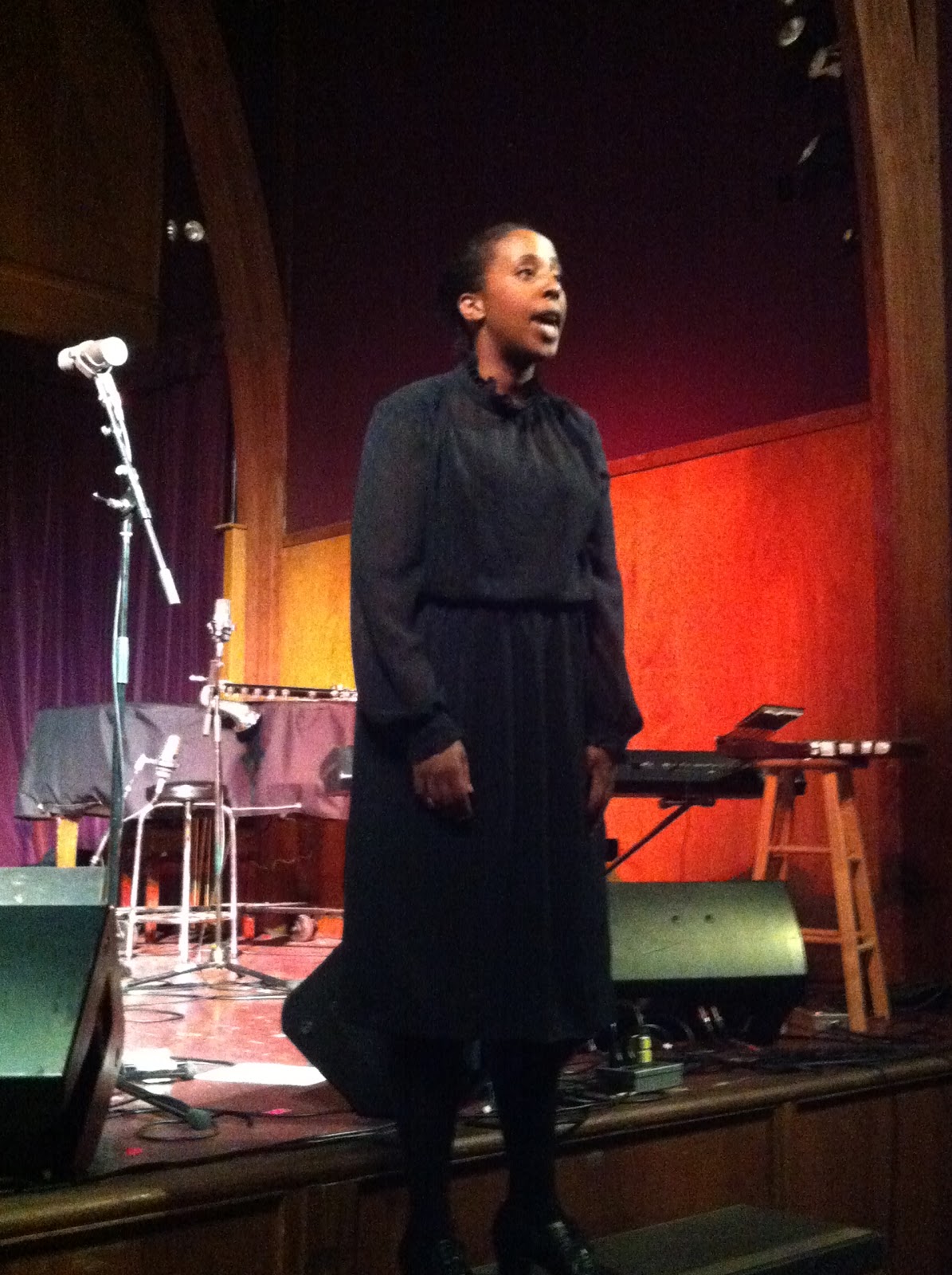
Cold Specks - St James Hall - November 21, 2012

This review can also be found on http://concertaddicts.ca/2012/11/23/review-cold-specks-st-james-hall-november-21st-2012/?doing_wp_cron=1353698350.7617120742797851562500 (or if you'd prefer a shorter version: http://goo.gl/rSouB).


The crowd at St James Hall on Wednesday, November 21 was very diverse: all ages, multiple ethnicities, a 50/50 split of men to women, and from conversations I overheard whilst waiting to be let in and waiting for the show to begin, a good number of supporters from the local Rogue Folk Club. The venue appeared to be converted from a keelboat framed church to a concert venue, with the front half of rows comprising individual chairs and the back half made of pews. Their website tells me it’s called the Sanctuary Hall and has been part of the building for approx. 100 years. 

Ah, border crossings. Bane of the musician’s travelling existence. In this evening’s case, the show was delayed by an hour. The waiting crowd was good-natured and patient and by the time the grumbling started, the doors opened at 8 pm. This was a full house – every seat was taken, and people were standing at the back and on the west side of the hall. I spoke with a staff member and she and I guesstimated there were a good 300 people there. Not a bad turnout at all!

The opener was Christopher Smith, a toqued and cardiganed singer/songwriter from Vancouver. He played pleasant and melodic songs, sometimes the lyrics got edgier, but Smith lets them stand on their own instead of having the melody follow them to darker subjects. He has a higher than average voice, breathy but not falsetto. Smith’s songs tend not to be structured in traditional verse/chorus conventions, more like poetry set to music – which sounds nice (and his imagery is interesting as well), but it makes it a little difficult for the audience to recognise when a song is over (cue the applause). Not much audience interaction, but every song was introduced in turn and Christopher Smith has a nice sense of humour. Although certainly not an unpleasant way to spend 20-ish minutes, there isn’t a lot to take away with you, unless you purchase a CD. 

Waiting for Cold Specks to take the stage, my brain got some exercise in remembering the names of less seen instruments: tenor saxophone, bass saxophone (that at first glance I mistook for a bassoon), and baritone saxophone. Beside the piano was something that looked like a zither, but it had hammers mounted to one side enabling the piano player to enable playing of the instrument by pushing keys – very pianolike. 

The first song was Peace in the Valley, sung a capella which then segued into a piece I didn’t get the name of featuring bass saxophone, as well as rhythm and lead guitar, the vibrations of which set the snare off, which was a really, dare I say it, neat effect. Next was Blank Maps, the first song of the night to give me chills. The sound seemed to fill the room, and I mean every nook and cranny of the room. It was a nicely rhythmic song. Heavy Hands had a memorable echoey effect on lead guitar. Winter Solstice begins with Al a capella and showcases the power and expressive range of her voice with great drive from the drums when the rest of the band comes in, giving the song even more intensity. When the Lights Dim is another one of those songs that builds drama. Al starts with just her voice and the lead guitarist and when the rest of the band come in, it’s almost like they’re providing the colour to a song that started out in black and white. The next song I didn’t catch the name of and the lyrics were difficult to hear. The band was almost too loud and Al’s voice was virtually drowned out except for during a quiet bit in it. Reeling the Liars In is a short-ish, mellow song. Again, it starts out with Al singing, lead guitar, drummer playing tambourine as well as drums before the rest of the band comes in. Send Your Youth starts with Al singing, lead guitar and piano. After a while the saxophone, female background vocalist and drums lend their support. Very sad lyrically with a lonely, yet lovely sound. Elephant Head was next, the lyrics from which the album I Predict a Graceful Expulsion gets its title. It has Toronto-specific lyrics, and a haunting line about “1000 stillborn thoughts to cradle”. It’s Al and guitar for the first verses, then a focus on vocal harmonisation over intricate instrumentation when the rest of the band comes in. She shows she can hit the higher notes as well with this one. Incredibly moving song; I got chills again, and something that could be viewed as getting a lump in one’s throat (it was borderline). She then began an a capella / gospelly Fresh Prince of Bel Air with just vocals and drums which was abandoned after about a verse. I didn’t understand why people were tittering when she began it (I’d obviously not made the connection), but eventually clued in. Holland was the next song played, and again it begins with Al’s voice and guitar with focus on vocal harmony over instrument use until the drummer starts with the mallet on the tom driving the beat and the song swells into another “nook-and-cranny-filling number” before scaling it down to the level it begins with. Lay me down starts with Al on voice and guitar, and has a slow, steady, gorgeous build to it. In this setting, I’m thinking the drums are both her best friend and her worst enemy because it is the first instrument to drown her out and when the other instruments are full on, she doesn’t fight it, she doesn’t push harder to make herself heard but it’s bass, rhythm guitar, lead guitar, drums, piano, saxophone, backing vocal against her, and she just doesn’t come out the winner in that contest. A standing ovation concludes the set. Al comes back, not to the stage, but to the steps that go to the floor where she sings Old Stepstone completely a capella and unamplified, an inkling of why she was nominated for the Polaris Prize. And that song concluded the evening’s musical festivities at 9:50 pm.     

Observational note, the bass player had one of the hardest tasks to perform – he played on only a handful of songs (he didn’t even come on stage until When the Lights Dim) and instead of repeated exits/entrances, he did his best to be invisible, crouching down on one knee, instrument across the other knee, head bent away from the audience, everything to imply I’m not actually here when he wasn’t playing. The other musicians did the same, but for the crouching, when they weren’t playing, which is de rigeur and it usually works but sometimes you may as well just hang a marquee above your head for all your attempts come to nought.

Al said this was either the first time they played together as that band or the first time they played as a band in Vancouver. Considering how little interaction there was between band members, I’m guessing it’s the latter because they just ‘got on with it’ – everyone knew what they were doing and when. Very professional; very proficient. Al’s singing style does not lend itself to the clearest diction, but what a voice! I’d first heard her music on an episode of CBC Radio 2’s The Strombo Show and recorded she sounds great. Live, even better. A church hall was a great and atmospherically, super suitable. That’s not to say Cold Specks wouldn’t do well in a larger venue, they’ve just got a bit of a ways to go.

These photos are by me. Photos taken by Jamie Taylor can be found at the http://www.concertaddicts.ca link above.

Wednesday, November 21, 2012

TV I like: George Gently - Series 1, Episode 1

At the end of the pilot, viewers knew there was a show. Gently informed Bacchus he was no longer retiring and was staying on, ostensibly to keep Bacchus on the ‘straight and narrow’, the latter having shown his “the end justifies the means” philosophy/habit that Gently is determined to break him of. He tells the story of one police officer who he didn’t take under his wing and that officer is now one of the most corrupt currently serving in the Met. Whether viewers will ever meet the man, remains to be seen. In the meantime, we have this episode, entitled The Burning Man, based on Alan Hunter’s book “Gently Where The Road Goes” and set in Northumberland of 1964. 

A burnt body is found and a young woman reports her father as missing. It draws the interest of a Commander Empton of Special Branch, who befriends and cultivates Bacchus as a potential new recruit, a position Bacchus would be eager to fill, who although he has good instincts, just doesn’t have the experience to navigate slippery Special Branch tactics. Gently keeps his distance and is none too impressed with the budding rapport between his Sergeant and the Special Branch man. An IRA connection is quickly found, and Gently’s objective is to stay ahead of what Special Branch is up to and solve the case properly. After about one hour into the episode, Empton finally shares what he knows and why he’s interested in the case – one that turns out involving an actively serving man from the IRA with the nickname “the Sniper” working undercover in Northumberland in an effort to procure weapons for the Republican cause using a contact at RAF Huxford and there’s another half hour of shenanigans that follows.


The guest cast listed in the opening is again substantial – I recognised Robert Glenister (playing Commander Empton) and Pooky Quesnel (playing Wanda Lane, a middle-aged Irish woman with ties to the missing IRA man and who tries to seduce Gently) immediately, but other names listed were not familiar at all: John Kavanagh (playing Doyle) and Tony Rohr, who played China, previously played by Sean McGinley. Faces I recognised were those of Finbar Lynch as Ruari O’Connell and Tom Beard playing the RAF officer Campling in charge of Huxford.


Contextualising 1964:

* Forensic science of the day also includes analysis of dental records

As much as I like spy stories (I liked the Bourne films, even parts of Bourne Legacy, I like 007 films, one of my favourite television programmes is Spooks), I find double agent storylines a bit tiring. What has also already begun to wear on me is Bacchus’s frequent need to say “I’m sorry” – is this just because a position at Special Branch was dangled in front of him, or is this going to be the overall tone of the show? What about the next time someone presents him with a carrot? Is he going to be the young guy falling for it every time but managing to redeem himself by making connections between clues etc. showing his boss he’s not completely incompetent? 


Viewers knew from the get-go that this 'pairing' is not between equals – it's definitely more of a mentor/pupil dynamic, at least from Gently’s side. Bacchus wants to be viewed as an equal partner, but will the show support growth in that direction, and maybe even more interestingly, will Gently accept him as such, assuming the writers decide to go that way. 

Next episode: Series 1, Episode 2 - Bomber's Moon

Monday, November 19, 2012

TV I like: George Gently - Pilot


The opening episode from 2007 begins in 1964 London with George Gently, a Chief Inspector at Scotland Yard, attending his wife’s funeral, the accident that took her life playing in his mind during it. Based on a story by Alan Hunter entitled “Gently Go Man”, he transfers to Northumberland following a lead that he thinks will bring the man he believes to be behind his wife’s death to justice. Once in Northumberland, he effectively poaches the case from the local police and works with an ambitious and keen Det Sergeant, John Bacchus, who, despite his youth is very confident in his abilities but lacking in experience and what also becomes clear, incredibly middle class (very homophobic, borderline racist, materially focussed, a bit of a social climber, with a disdain for the wealthy and privileged, but I don’t think he’ll be too conservative to engage in adultery) and very eager to work with someone of Gently’s stature. Nicknamed “St George”, Gently is concerned about corruption in the police force which I think will be a recurring theme for this programme.   

The cast in this episode is impressive: Martin Shaw and Lee Ingleby all have fairly established careers. In addition, Sean McGinley as Gently’s Irish snitch China who Gently brings to Northumberland; Richard Armitage is Ricky Deeming, the leader of the “Durham Defenders” motorcycle gang and, as it turns out, knows Bacchus from grammar school; Phil Davis is Joe Webster, the London gangster Gently was investigating and who disappears north after Gently’s wife’s death with Durham connections; and Clare Rushbrook plays Valerie Lister, mother of a youth who is at the centre of the case that brings Gently north were listed as guest stars in the opening credits. Other familiar faces included those of Neil Watkins, Shaun Evans 

Contextualising 1964: 
* Forensic science is being used in that blood analysis is mentioned and
   Northumberland has a forensics 
department.
* The amphetamine “speed” is already in circulation. 
* World War II ended only 9 years previously. 
* Murder is a hanging offense

This cohesively structured episode was shot in Ireland and directed by Euros Lyn, a name I recognised primarily from Doctor Who. The dynamic to drive the plot forward will undoubtedly come from these two characters. Gently and Bacchus have different views on morality and on what constitutes justice and since their professional purpose is to enforce the law, this is clearly where much tension and drama will originate from.  

Photo from blogcritics.org.

Monday, October 29, 2012

Snow Patrol / Noel Gallagher's High Flying Birds / Jake Bugg - October 25. 2012 - Vancouver

Oh, Vancouver, how you disappoint me sometimes. This entire evening can be summed up with the question: Vancouver, why were you even here? There was a chance this could have been my first review for www.concertaddicts.ca but under the circumstances, it's just as well it isn't.
 

To wit, the opening act was a young man by the name of Jake Bugg whose interaction with the audience could best be described as "minimal". He did make the effort to introduce each song, mostly with a "this song is called such and such from the CD". But, when he introduced one song as one being inspired by his home town, he did not elaborate. What, pray tell, is the name of your home town? Where is it? What aspect(s) of the town prompted you to write the song? Nope, just the song, with depressing lyrics, so that combined with the way he pronounces his "U"s, I'm thinking he's a northerner.* To his credit, he spared the audience the clichéd "it goes something like this" type introduction, which has always irked me: if you tell me it's an approximation of a song you supposedly wrote, why should I consider you a professional, or part with my money to purchase your CD? 

Back to young Jake, singer/songwriter playing a plugged-in acoustic guitar producing wonderfully warm and rich tones. As a musician, he's certainly proficient enough, with influences from the likes of Dylan (who Noel Gallagher has compared Bugg to) through to bluegrass. With the single Two Fingers, I thought he was almost channelling a bit of Noel Gallagher himself, so I'm not surprised he considers himself a fan. I don't understand why Mr Gallagher is supposed to have said Bugg represented "the future of music" - Dylan meets Arctic Monkeys was another comparison I've heard recently. Really? Arctic Monkeys don't twang! Nuff said. Although Bugg is benefitting from a lot of "buzz", the venue really didn't suit him. Biltmore Cabaret - yes! Media Lounge - sure. Studio 700 at CBC - I didn't overly love this guy's music but I wouldn't do that to him. Rogers Arena, mmmmkay. Maybe, with more of a show and backing musicians. He didn't own his stage, but then technically speaking, it wasn't his - even if the acts he's supporting are virtually pushing him into that spotlight with their support of him. My verdict: reserving judgement.
 

To Noel Gallagher and his High Flying Birds. To be honest, I felt a little sorry for the guy: the "bring on Snow Patrol" catcalls, the requests for Oasis songs "Oasis? That was years ago!" Might be par for the course, and he's got a thick skin, but even if a fraction of what I was hearing in my 15th row seat registered, it wouldn't have been a pleasant experience. They registered with me and I thought it was really rude.

The Setlist:
If I had a gun (performed with some great drive to it. Sounded great!)
The Death of You and Me - I swear that upright piano was either out of tune or pianist got his keys wrong - I can handle jarring chords, but that was ridiculous.
Supersonic (after audience cajoling and "what the F**k" responses, people were treated to the Oasis tune)
Dream on (very nice)
AKA...What a Life! (Great beat for this one, almost disco-like, but wonderful energy)
Talk Tonight (totally forgot this was an Oasis tune - live it had a really nice groove to it)
AKA...Broken Arrow (dedicated to the ladies, performed with a bit of a scowl (or maybe that's permanent). It struck me how incredibly radio-friendly this song could be.)
Half the World Away (again, forgot this was an Oasis song. I really don't remember their entire catalogue, but I'm glad he didn't just regurgitate single after single. On an observational note: is it because it's a two-step that virtually every coupled-up pair was prompted to simultaneously put their arms around each other's waist/shoulder? Looked odd. Does that song have subliminal signals that are lost on 'singletons'?)
Stranded on the Way Down (is it just me or is this song reminiscent of Supersonic?)
Whatever
(Another one from the Oasis back-catalogue. The chords and the piano part sounded so much like Handbags and Gladrags by Stereophonics (otherwise known as the theme song to The Office, original UK version) it was distracting. Good tune though.
Don't Look Back in Anger (I thought it was an interesting choice, given what's always been circulating in the media, because he can't, really, can he (look back in anger, that is)? Besides, the CD he's promoting only has 10 songs on it and he was the chief songwriter for the band from years ago. Stark contrast to his brother singing Wonderwall at the Closing Ceremonies for the Olympic Games in London. Lawyers talking to lawyers for permission perhaps? But I digress.)


Noel Gallagher's High Flying Birds's set was done by 9:15 pm and the 20-minute tear-down/set-up break gave me the chance to reflect on the seated row arrangement. 

A huge drawback to having assigned seats and rows is that there's no huddling of the masses. No ambient body heat from the person fewer than 6 inches away. If there's no dancing, no people close by, and you're in a T-shirt for example, you're seriously screwed, and in my case, shivering as you type. Bloody'ell, it was cold, even without sitting on ice. Another drawback is that the people in the front rows can legally (sanctioned by the arena stewards) spread out along the stage and aren't made to say in their assigned seats. The rest of us who actually were there for Snow Patrol weren't so lucky.

The Setlist
(comments minimal as this was the third time this year I'd seen Snow Patrol in concert):
Final Straw
Take Back the City
Hands Open
(hadn't really noticed how much of a grounding influence Nathan Connelly's guitar is - it seemed to control the speed, not the rhythm section)
Crack the Shutters (dedicated to Jonny Quinn and his wife's impending parenthood) 

This isn't everything you are
Run
The next song was going to be something Snow Patrol have rarely played outside the UK and the sound karked out so we fast forwarded to the next one. Haven't a clue what it's called as Lightbody only got a line and a half into it.
Shut your eyes (audience participation: boooooo)
Chasing Cars
Called out in the Dark

Fallen Empires (holy, mad ukulele skills there, Mr Connelly)
Open Your Eyes
Just say Yes
 

And then it was over. No encore. Off the stage at 10:50 pm and I think I was home within half an hour.

Considering how many people were doing the "get Snow Patrol on stage" catcalls, there was remarkably little dancing. In the area immediately around me (beside and in front of me), people left in between sets and did not return. Those remaining in the stands did not dance, did not stand (we on the Floors had to), didn't really do much of anything. What little participation Gary Lightbody asked of the audience was lacklustre, to say the least. On the whole, they were "kind of lame", and I'm being kind. They cheered nicely enough when the Wookie said "good night", but that's about it. If I'd thought of it, I would've unofficially polled the audience with the question: So, why are you here? Who did you want to see? I'm guessing in many cases the answer would've been: "because I could" / "it seemed like a good idea at the time". Guess what, it wasn't. By contrast, when Snow Patrol played The Orpheum in May of this year, it was pandemonium. It was so much fun because every one of the close to 2800 people there, were there for this band. I'm not saying that this 12,000-14,000+ venue was too big for them, but what would have made it so much better if people hadn't been so frustratingly passive. I therefore shouldn't have felt cheated about not getting an encore - Vancouver did not deserve one this time.    


* Wikipedia tells me he's from Clifton, Nottinghamshire.
Jake Bugg photo from www.gigwise.com
Photo of Noel Gallagher's High Flying Birds from www.atlanticmusicguide.com
Photo of Snow Patrol from www.straight.com